Outdoor greenhouse supplementation is becoming more precise, not simply brighter. The real question is: can grow lights be used for outdoor greenhouse supplementation? Yes, when natural sunlight remains insufficient for crop targets. A greenhouse still loses usable light during cloudy mornings, winter afternoons, and heavily shaded periods. Supplemental fixtures can stabilize daily light integral, improve flowering consistency, and protect transplant schedules.
The U.S. Department of Energy’s Solid-State Lighting research identifies LED efficiency and controllability as major advantages for horticultural applications. The DesignLights Consortium’s Horticultural Technical Requirements also emphasizes measurable performance, including photosynthetic photon efficacy, photon flux, and spectrum. These metrics matter more than advertised wattage. A 1,000-watt fixture may waste energy if its photons miss the canopy. Look for tested PPE, reliable thermal management, dimming controls, and a suitable beam pattern.
The 2022 USDA Census of Agriculture confirms the commercial importance of protected horticulture in the United States. Yet, no single grow light wins every greenhouse. Tomato vines, leafy greens, seedlings, and flowering crops require different intensities and photoperiods. A practical evaluation should compare PPFD maps, energy use, installation height, humidity resistance, and maintenance access. In a real house, condensation can collect on lenses before sunrise. That detail is easy to overlook. Growers should also calculate local electricity costs and seasonal sunlight before purchasing. This guide examines the leading 2026 options through those technical and operational priorities. Some recommendations may change as manufacturers publish better independent data. That uncertainty deserves attention.
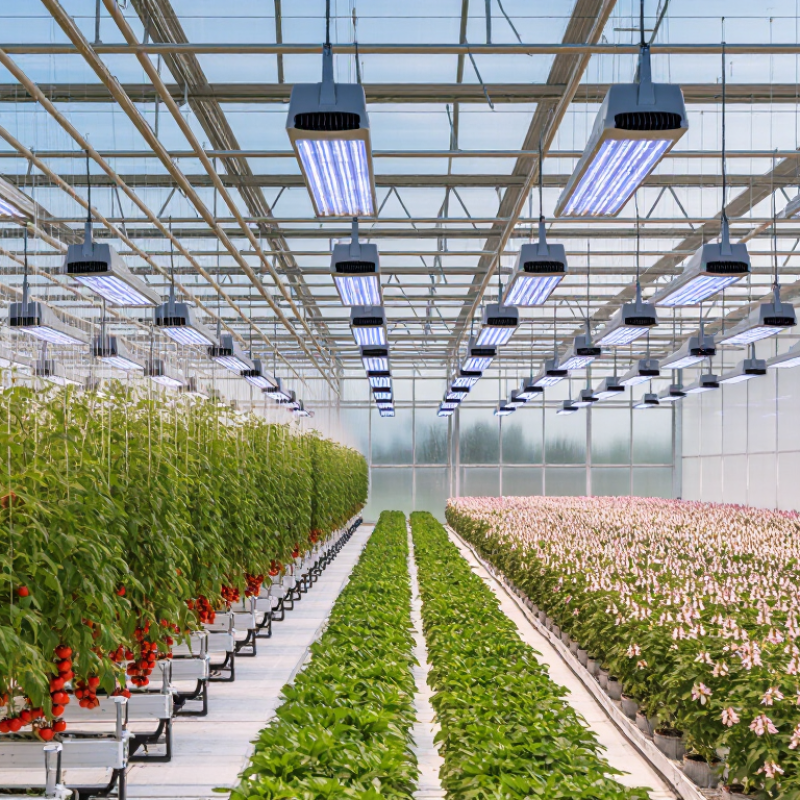
What Makes a Grow Light Suitable for Outdoor Greenhouse Supplementation?
A suitable grow light for outdoor greenhouse supplementation must respond to sunlight, not replace it blindly. The key measurement is PPFD, expressed in micromoles per square metre per second. Daily light integral, or DLI, shows the total usable light received by crops. Many leafy greens perform well around 12–17 mol/m²/day, while fruiting crops often need more, according to greenhouse production guidance from universities and extension services.
Efficiency matters during long winter nights. The U.S. Department of Energy’s 2023 Solid-State Lighting R&D Opportunities report highlights photon efficacy, heat control, and intelligent dimming as major horticultural priorities. Look for measured output near 2.5 µmol/J or higher, while checking the test conditions carefully. A fixture may appear powerful, yet waste energy above the canopy. Good units distribute light evenly across benches and maintain stable output in cool, humid air.
Tips: Measure sunlight at crop height before choosing wattage. Use a PAR meter, not a phone camera. Set supplemental lighting by DLI targets, then adjust weekly. Keep fixtures away from wet leaves and provide safe cable routing. Red and blue light are useful, but a broader spectrum usually supports more natural plant shape. I have found that automatic dimming saves energy, although sensors sometimes misread bright, reflective greenhouse panels. That detail deserves checking. Temperature also changes performance; verify the manufacturer’s independent test data, not only marketing claims.
How to Compare Light Spectrum, Intensity, and Daily Light Integral
In 2026, greenhouse supplement lights should be compared by spectrum, intensity, and daily light integral, not wattage alone. I measure sunlight at canopy height with a quantum sensor, because roof glass, dust, and seasonal angles can change readings quickly. ASABE S640.1-2023 defines photosynthetic photon flux density using 400–700 nanometers, while extended measurements may include 400–750 nanometers.
Spectrum must match the crop and growth stage. Leafy greens often perform well around 12–17 mol/m²/day, while fruiting crops may need roughly 20–30 mol/m²/day, according to controlled-environment guidance from Cornell University. These are working ranges, not guarantees. Some cultivars respond differently. I would avoid treating a strong red-heavy spectrum as automatically superior; blue photons can influence compact growth, leaf structure, and quality.
Calculate supplemental light from the missing DLI. If sunlight supplies 10 mol/m²/day and the crop target is 20, ten additional moles are required. Delivering them across 14 hours requires about 198 µmol/m²/s. Check uniformity at the edges, not only beneath the fixture. The DesignLights Consortium’s Horticultural Lighting Technical Requirements, Version 3.0, evaluates photon efficacy and distribution, helping compare useful output against energy use. A practical target is near 2.5–3.0 µmol/J for efficient systems, though fixture conditions affect performance. My earlier mistake was trusting the center reading; plants at the bench corners told a different story.
How to Size, Position, and Schedule Supplemental Greenhouse Lighting
2026 Top Grow Lights for Outdoor Greenhouse Supplementation?
How to Size, Position, and Schedule Supplemental Greenhouse Lighting
Supplemental lighting should begin with the crop, not the fixture. Measure greenhouse length and width, then calculate the growing area in square meters. Leafy greens may perform well near 150–250 µmol/m²/s, while fruiting crops often need more intense light. Use a quantum sensor to check PPFD at plant height, because fixture wattage alone proves very little. A practical target is often a daily light integral between 12 and 20 mol/m²/day, depending on crop and season. Keep a written record. Guessing wastes electricity.
Position lights evenly above the canopy, usually 0.6–1.2 meters away, while following the manufacturer’s safety instructions. Check the corners and greenhouse edges; these areas often receive less light. Overlap light patterns gently rather than creating bright circles. During cloudy winter days, run lights in the morning or extend the afternoon, commonly for two to six hours. A timer linked to a light sensor can prevent unnecessary operation on sunny days. Keep a dark period for crops that need regular night cycles. Never let fixtures overheat plastic, leaves, or irrigation lines.
A weekly canopy check matters. Watch for stretched stems, pale leaves, or bleached tips. These signs can expose poor placement or excessive intensity. My own first calculation would probably be too optimistic without measuring sunlight changes. Greenhouse conditions shift quickly. Adjust slowly, perhaps by 10% each week, and record plant response before changing the schedule again.
2026 Top Grow Lights for Outdoor Greenhouse Supplementation
How to size, position, and schedule supplemental greenhouse lighting
How to use this chart:
To add 6 mol/m²/day of supplemental light, a greenhouse operating an 8-hour lighting period needs approximately 208 µmol/m²/s at canopy level. Extending the photoperiod reduces the required PPFD, but lighting should be scheduled around natural daylight and crop-specific limits.
Sizing formula:
Required PPFD = Supplemental DLI × 1,000,000 ÷ (3,600 × lighting hours). Measure PPFD at plant-canopy height and use overlapping fixtures to maintain uniform coverage.
Conclusion
Choosing the right grow light for outdoor greenhouse supplementation starts with matching the fixture to the plants, climate, and available daylight. The key question is: can grow lights be used for outdoor greenhouse supplementation? Yes, they can help maintain consistent growth when natural sunlight is weak, seasonal, or limited by weather. Compare full-spectrum output, light intensity, coverage, and daily light integral (DLI) to determine whether plants receive enough usable light without unnecessary energy use. Different technologies may suit different greenhouse sizes, crop stages, and installation heights.
Effective planning also requires correct fixture spacing, mounting height, aiming, and scheduling. Supplemental lights should extend the day or support low-light periods rather than operate continuously. Before installation, check electrical safety, heat management, moisture protection, weather resistance, controls, and operating costs. A reliable system should tolerate greenhouse humidity and temperature changes while delivering even, efficient illumination. Careful monitoring and adjustment can improve plant quality, reduce wasted energy, and create a stable growing environment throughout the year.

