Why are my plants burning under the grow light? The first clue may be a dry, pale patch on the leaves closest to the fixture. Sometimes the edges curl upward. Yet leaf damage does not always mean the lamp is too hot. Excessive light intensity, long daily exposure, poor airflow, or watering problems can create similar symptoms. That uncertainty matters. A quick diagnosis based on one yellow leaf can lead to the wrong adjustment.
Plant physiologist Dr. Bruce Bugbee’s research offers a useful principle: match light intensity to the plant’s needs and growth stage. This is a paraphrase, not a verbatim quotation. With China best grow lights, adjustable dimming and careful placement can help, but no fixture guarantees that every plant will thrive at the same distance. Check the manufacturer’s guidance, then observe the canopy. Are upper leaves bleaching while lower leaves remain green? Is the pot drying unusually fast? Measure the light if you can, and change one factor at a time. Move the lamp higher or reduce its intensity, then watch new growth over several days. Do not expect damaged leaves to recover fully. I have to admit, the symptoms can be frustratingly vague. A simple light-and-watering log may reveal more than repeated guesswork.
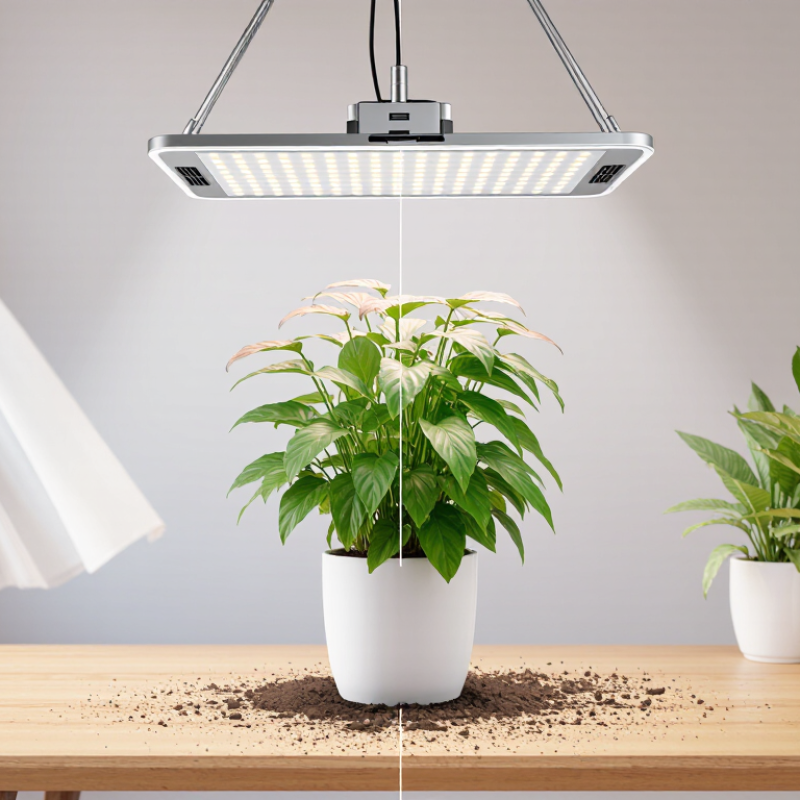
China Best Grow Lights: Why Are My Plants Burning?
PAR means photosynthetically active radiation: light between 400 and 700 nanometers that plants use for photosynthesis. The ANSI/ASABE S640 standard defines how plant-light measurements are expressed, including photosynthetic photon flux density (PPFD). PPFD counts PAR photons reaching a surface each second. It does not, by itself, predict whether a leaf will burn.
A useful distinction: wavelength describes the light, while intensity and exposure describe the dose. McCree’s 1972 study measured photosynthetic responses across 22 crop species, showing that plants do not respond equally to every wavelength within PAR. But there is no universal PPFD threshold for leaf damage. Species, prior light exposure, distance from the fixture, and leaf temperature all matter. A pale patch on the upper leaves may signal excess light; dry, crispy edges can also point to heat or watering stress.
Check the canopy, not just the lamp setting. Measure PPFD at leaf height, then compare it with guidance for your plant and growth stage. If the top leaves feel warm, lift the fixture or reduce output gradually. Watch new growth for several days. I would not diagnose burn from one yellow leaf alone; that clue is easy to overread.
| Topic | Practical definition or guide | What to check |
|---|---|---|
| PAR | Photosynthetically Active Radiation is the 400–700 nm waveband commonly used to describe light available for photosynthesis. | PAR describes a wavelength range; it is not, by itself, a measure of how much light reaches a leaf. |
| PPFD | Photosynthetic Photon Flux Density measures PAR photons arriving at a surface each second, usually in µmol·m⁻²·s⁻¹. | Measure at canopy height and at several points; light intensity can vary across a growing area. |
| Light burn | Plant injury associated with excessive light exposure at the leaf surface. High PPFD, long exposure, or a sudden increase can contribute; heat and other stresses may also be involved. | Look for bleaching, fading, or dry, crispy patches on the most exposed upper leaves. These signs are not conclusive on their own. |
| Approximate PPFD guide | Many low-light foliage plants are grown around 50–150; moderate-light plants around 100–300; and many high-light fruiting crops around 400–800 µmol·m⁻²·s⁻¹. | These are broad starting ranges, not universal limits. Species, growth stage, temperature, CO₂, and acclimation affect tolerance. |
| Daily Light Integral (DLI) | DLI estimates total PAR received per day in mol·m⁻²·d⁻¹. Formula: DLI = PPFD × lighting hours × 0.0036. | For example, 300 µmol·m⁻²·s⁻¹ for 12 hours gives a DLI of about 13.0 mol·m⁻²·d⁻¹. |
| Light burn or heat stress? | The two can occur together. Leaf temperature, airflow, water status, and distance from the fixture can affect symptoms. | Check leaf temperature and growing conditions as well as PPFD; a PAR reading alone cannot identify the cause of damage. |
| Safer adjustment | If damage appears after an increase in light, reduce intensity or daily exposure gradually and allow plants time to acclimate. | Recheck canopy PPFD and new growth over several days; avoid relying on fixture distance alone because output and coverage differ. |
Note: PPFD ranges are general horticultural guidance. Plant-specific recommendations and reliable canopy measurements take precedence.
PAR is photosynthetically active radiation, spanning wavelengths from 400 to 700 nanometers. Plants use this light for photosynthesis.
No. PPFD measures PAR photons reaching a surface each second, but it cannot predict leaf damage alone.
Damage often appears on the highest leaves closest to the light. Leaves may bleach, curl upward, or develop dry patches. Check the pattern.
Light stress often affects upper leaves first. Heat can worsen when air is warm and stagnant. Feel the leaves, not just the room.
Measure PPFD at leaf height and compare it with guidance for your plant and growth stage. Phone meter readings are rough estimates.
No. A single yellow leaf is easy to overread, and I may do that too.
Wilting with damp soil may indicate root stress. Bone-dry soil can cause crisp edges, while excess fertilizer may brown leaf tips.
If leaves feel warm, raise the light slightly or improve airflow. Change one factor at a time, then watch new growth for several days.
If you’re asking, “why are my plants burning under the grow light,” the cause may be excessive light stress rather than heat, watering, or nutrient problems. Light used for photosynthesis falls within the 400–700 nm range, known as photosynthetically active radiation (PAR). Check for signs of light stress, such as bleaching or damage concentrated on upper leaves, and compare them with symptoms that may point to hot conditions, inconsistent watering, or nutrient imbalance.
Measure PPFD at canopy level and estimate daily light integral (DLI) with this formula: PPFD × hours of light × 0.0036. When comparing China-made grow lights, consider both efficacy, measured in μmol/J, and whether the fixture offers reliable dimming control. If light exposure appears too intense, reduce PPFD or shorten the photoperiod gradually. Then observe the plants and recheck canopy readings before making further changes.

