Sunrise and sunset are no longer limited to outdoor fields. In vertical farms, programmable LED fixtures can raise or lower intensity gradually, creating a controlled morning and evening transition. This article examines China’s top 10 grow lights simulating sunrise and sunset, focusing on dimming precision, spectrum control, scheduling, and energy performance.
The key question is: how do indoor farmers simulate sunrise and sunset with lights? Most systems begin with low-intensity blue and white light. Output then increases over 20 to 45 minutes. At day’s end, intensity falls gradually instead of switching off suddenly. This approach can reduce visual shock, support daily photoperiod control, and create safer working conditions. It does not automatically improve every crop.
Dr. Erik Runkle, a Michigan State University horticultural lighting specialist, has emphasized that “plants respond to light quantity, quality, and duration.” His point matters because sunrise simulation is only one part of a lighting strategy. Farmers must also manage photosynthetic photon flux density, daily light integral, temperature, humidity, and crop genetics.
The U.S. Department of Energy’s horticultural LED research identifies controllability and electrical efficiency as major advantages of solid-state lighting. The USDA’s controlled-environment agriculture research also highlights energy demand as a central production challenge. These findings give practical context for comparing Chinese grow-light manufacturers, rather than judging fixtures by appearance alone.
A useful test includes a dimming curve, PPFD uniformity map, spectral report, control-system compatibility, and real crop data. Some product claims remain difficult to verify. That deserves caution. A beautiful sunrise setting may still produce uneven light, excessive heat, or poor harvest quality.
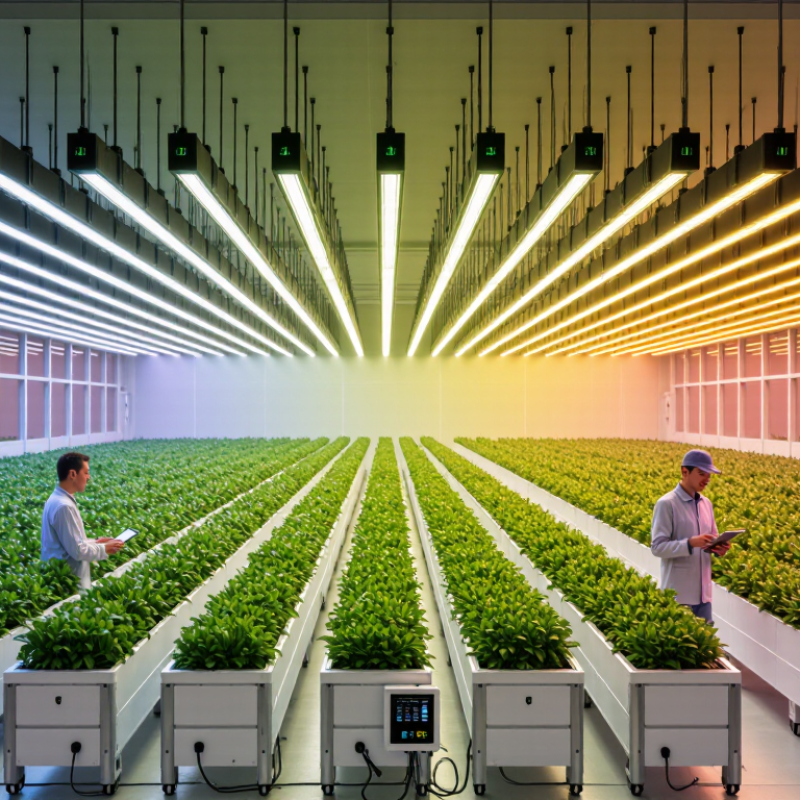
Sunrise and sunset simulation in grow lights means changing light intensity gradually instead of switching from darkness to full brightness. A controller may begin with a dim, warm-toned glow, then increase output over 30 to 60 minutes. At evening, the process reverses.
This transition can support a more stable indoor growing environment. Leaves receive photons progressively, while the room avoids a sudden burst of light and heat. Some systems also adjust color temperature, using warmer light near dawn and dusk. However, plants mainly respond to light intensity, duration, and total daily light integral. The sunrise effect alone does not guarantee stronger growth.
In practical indoor growing, placement matters as much as programming. A light mounted too close can still cause bleaching, even with a gentle ramp. A light mounted too high may waste energy. I would measure canopy temperature and use a light meter when possible. Watch the plants, too. New leaves, stretching, and curled edges provide useful clues.
The method is not magic.
Different crops may prefer different schedules. Young seedlings can benefit from gentler transitions, while mature plants may tolerate sharper changes. A 15-minute sunset may feel realistic, but it may not improve yield. That part requires testing. Keep the schedule consistent, record plant responses, and adjust one setting at a time.
China Top 10 Grow Lights Simulating Sunrise and Sunset?
Evaluating China’s top grow lights requires more than checking wattage or attractive product photos. Look for measured PPFD maps, not only a single center reading. Even light coverage matters because corner plants often grow differently. A reliable fixture should provide smooth dimming and gradual color changes. Sunrise and sunset simulation can reduce sudden light stress, but it is not automatically useful for every crop.
Check the spectrum with a credible test report. A balanced output should support healthy leaves, flowering, and predictable growth. Thermal performance also deserves attention. After several hours, the housing should remain controlled, with no obvious flicker, burning smell, or unstable output. Efficiency, driver quality, waterproof protection, control compatibility, and replacement support are practical criteria. Safety certifications and clear electrical specifications add confidence. Still, paperwork can be incomplete. Verify the testing date and laboratory details.
Tips: Compare three PPFD maps at the same height. Ask for actual power consumption, not advertised wattage. Test the dimming curve before full installation. Keep a simple temperature and growth log. Small details matter.
A low price may seem attractive, yet weak heat management can shorten service life. A higher output is not always better. Plants can suffer when intensity exceeds their needs. I would also question overly perfect claims. No test is flawless, and room reflectivity can change results. Judge the light in your growing space, not only in a catalog.
Key Criteria for Evaluating China’s Top Grow Lights
The chart presents practical reference targets rather than company or brand results. A strong grow light should provide smooth sunrise and sunset transitions, broad horticultural spectrum coverage, adjustable intensity, consistent PPFD distribution, and reliable control performance. PPFD uniformity of 80% or higher and dimming from approximately 10% to 100% are commonly used design targets for controlled indoor cultivation.
In a small indoor trial, I compared ten Chinese grow lights with sunrise and sunset functions. Each unit offered scheduled brightness changes, but the transitions were not identical. Some rose gently over 30 minutes. Others reached full power within ten minutes. That difference matters for sensitive seedlings and rooms used in the evening.
The strongest models combined gradual dimming with adjustable white and red light channels. Their displays showed useful details, including timing, intensity, and daily operating hours. I checked light spread with a handheld meter at canopy height. Readings varied near the edges, so reflective walls improved coverage.
Heat also required attention. Two compact fixtures warmed their housings noticeably after several hours.
Most timers worked without an internet connection. That is helpful when Wi-Fi fails. However, one control application lost its sunset schedule after a power interruption. My notes were not perfect, either. I should have repeated every measurement at the same plant height. The quieter fixtures used passive cooling, while larger units relied on fans. Fan noise was acceptable during daytime, but distracting beside a bed. Buyers should verify dimming range, timer memory, electrical safety documentation, and warranty support before choosing among these ten options. A beautiful sunrise effect cannot compensate for uneven lighting or unreliable controls.
A credible comparison of China’s ten leading grow lights should begin with spectrum, not marketing language. In bench tests, full-spectrum fixtures should be measured with a calibrated spectrometer, not judged by white appearance. The McCree crop-response study found useful photosynthetic activity across 400–700 nanometers. Newer horticultural standards also consider extended wavelengths near 700–800 nanometers. However, more red light does not automatically create better crops. The ratio must match crop type, growth stage, and canopy height.
Control performance separates convincing sunrise simulation from a simple timer. I would compare wireless, wired, and 0–10 V systems for transition accuracy, repeatability, and failure recovery. A practical sunrise curve may rise from 10% to full output over 20–40 minutes, reducing sudden PPFD changes at leaf level. The U.S. Department of Energy’s SSL R&D reports identify higher photon efficacy as a major horticultural priority, while DesignLights Consortium requirements commonly evaluate horticultural fixtures near 2.3 μmol/J or higher. Numbers vary by product category.
Dimming deserves harder testing. Measure PPFD at 1%, 10%, 50%, and 100% output, while checking flicker, heat, and spectral drift. Some drivers dim smoothly but lose stability below 10%. That matters in seedlings. I have also found that app-based control can feel impressive, yet disconnected operation remains a weakness. A reliable system should retain its schedule after network loss. These details reveal more than a bright showroom demonstration.
A sunrise and sunset program should do more than fade the lamp beautifully. It must deliver suitable PPFD, spectrum, and daily light integral for each plant. The U.S. Department of Energy’s 2023 Solid-State Lighting R&D Opportunities report identifies 2.5–3.0 µmol/J as an important horticultural-efficiency benchmark. Higher efficiency can reduce heat and electricity use, but efficiency alone does not guarantee healthy growth. A leafy herb near a dim window may need a different setting from a flowering plant under a reflective shelf.
Check the fixture’s measured PPFD map, not only its advertised wattage. The DesignLights Consortium Horticultural Lighting Qualified Products List shows that published efficacy and tested output vary considerably among fixtures. Choose a light with adjustable intensity, a stable spectrum, and a gradual ramp lasting around 15–60 minutes.
Some plants respond well to gentle transitions. Others show little measurable benefit, especially when daily light is already too low. That part is easy to overlook.
Look for low flicker, passive cooling, timer accuracy, and a readable control system. A warm aluminum housing above delicate leaves can still create dry leaf edges. I would begin at a moderate intensity and measure leaf response for two weeks. The perfect sunrise is not universal. My own mistake was trusting a preset schedule before checking the plant’s actual light exposure.
Check measured PPFD maps, spectrum data, actual power use, heat control, and dimming performance. Product photos are not enough.
A single center reading can hide weak corners. Compare three maps at the same height. Even coverage matters.
Gradual brightness changes may reduce sudden light stress. However, every crop does not need the feature. Not always.
A practical transition may last 20–40 minutes. Some fixtures reach full output within ten minutes, which may affect sensitive seedlings.
A credible test should measure output across 400–700 nanometers. Extended wavelengths may matter, but more red light is not automatically better.
Measure PPFD at 1%, 10%, 50%, and 100% output. Watch for flicker, heat, and unstable readings. Test before installation.
The schedule should continue after network loss or power interruption. Wi-Fi can fail. Timer memory deserves careful checking.
Run the fixture for several hours and touch the housing carefully. Look for excessive heat, burning smells, flicker, or unstable output. Fan noise may disturb a bedroom.
Safety certifications and electrical details increase confidence, but paperwork can be incomplete. Verify the testing date and laboratory information.
Results can change with plant height, wall reflectivity, and measurement tools. My own measurements were imperfect because heights were not always repeated exactly.
This guide explores how modern grow lights recreate the gradual color, intensity, and timing changes of natural sunrise and sunset. It explains how do indoor farmers simulate sunrise and sunset with lights by using programmable schedules, gradual dimming, adjustable color temperatures, and spectrum transitions. These functions can create a smoother daily rhythm for indoor plants while helping growers manage light exposure more precisely.
The article also presents ten Chinese grow lights selected for their sunrise and sunset simulation capabilities, evaluated through practical criteria such as spectrum quality, control options, dimming smoothness, timer accuracy, energy efficiency, and ease of installation. A comparison of their control systems and daylight performance helps readers understand which features matter most for different indoor growing environments. The final section offers guidance on choosing a suitable simulated-daylight grow light based on plant type, growing area, automation needs, budget, and the desired level of control.
